Featured OEM Titanium Bolts & Engineered Hardware
Engineered for mission-critical joints in automotive, superbike, aerospace, and high-corrosion industrial environments. Every component features rolled threads and calibrated load distribution flanges.
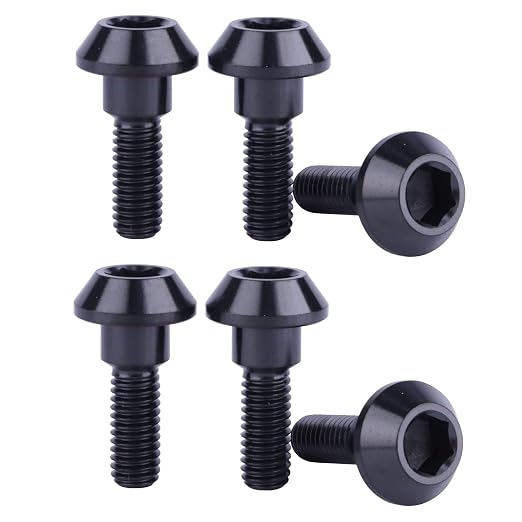
Titanium Motorcycle Brake Disc Bolt M6 X 20mm
- Grade:Ti-6Al-4V (Gr5)
- Thread:M6 × 1.0 Rolled
- Tensile ($R_m$):≥ 950 MPa
- Application:Rotor & Hub Assembly
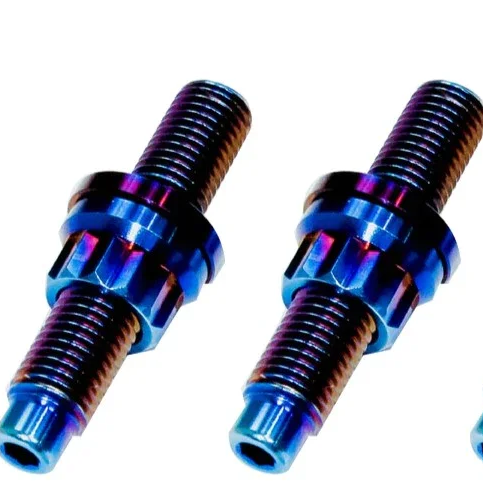
Car Exhaust Manifold Gr.5 Titanium Stud Kits
- Dimensions:M8 / M10 Flanged Sets
- Hardness:HRC 32–36
- Thermal Threshold:Continuous 450°C
- Feature:Anti-Seize Rolled Shank
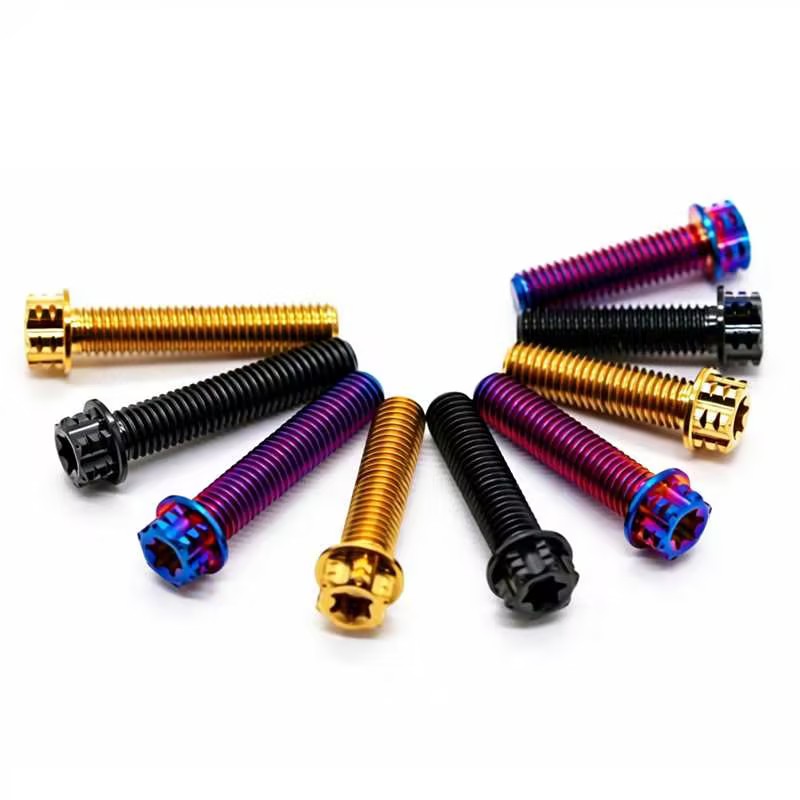
Titanium Torx Head Flange Bolt Class 8.8 / 10.9 Gr5
- Drive Standard:Torx (Star) Drive
- Surface Tech:Vacuum PVD Plasma
- Tolerance:ISO 965-1 Class 6g
- Finish:Stealth Black / TiN Gold
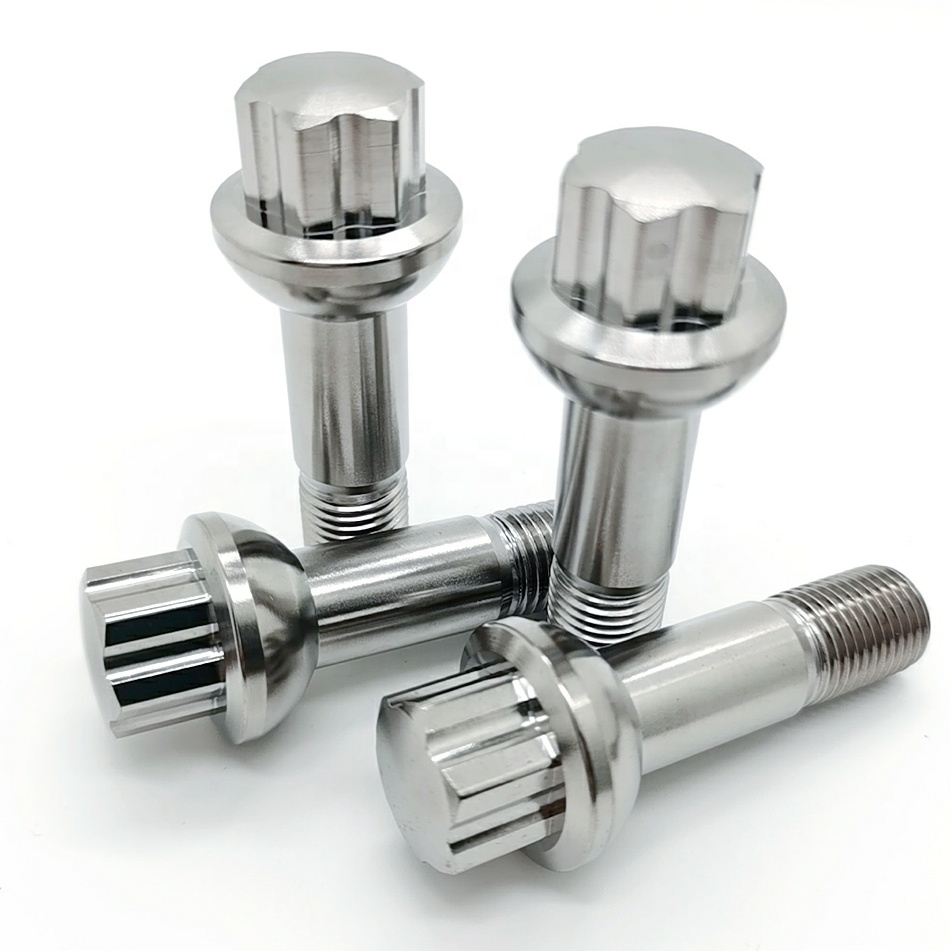
Forged Titanium Wheel Lug Bolts M14×1.5 / M12×1.25
- Seat Geometry:60° Conical / Ball Seat
- Yield Strength:≥ 828 MPa
- Weight Savings:45% vs. Grade 10.9
- Application:Track & Supercar Hubs
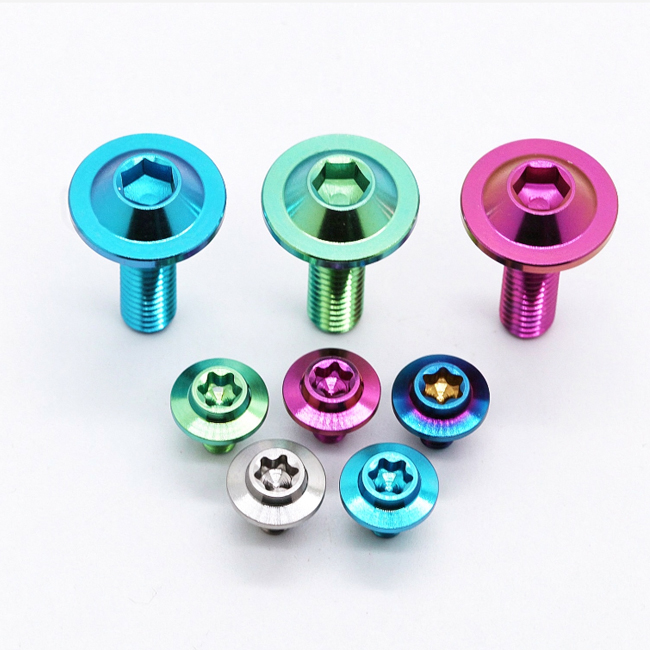
Anodized Rainbow GR5 Flange Head Socket Bolt
- Flange Type:Integral Smooth Washer
- Surface Anodizing:Electrolytic Rainbow / Burnt
- Standard:DIN 6921 Modified
- Corrosion Class:Salt Spray > 1,000h
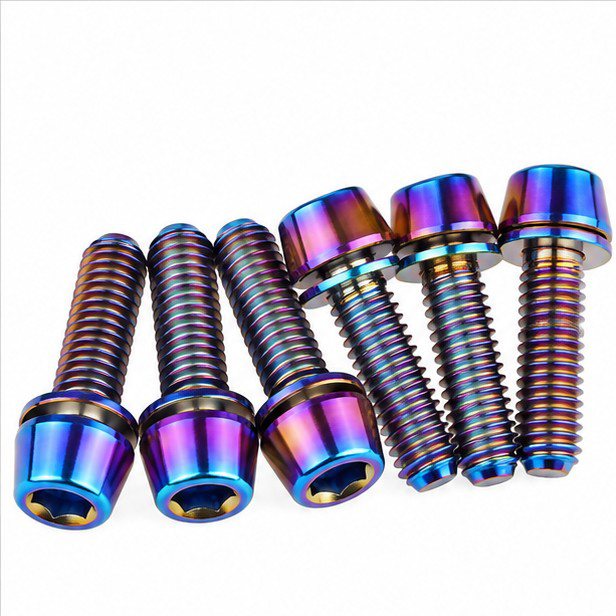
Burnt Blue Titanium M5 Bolt with Captive Washer
- Size Range:M5 × 16mm / 18mm / 20mm
- Washer Fit:Captive Anti-Friction
- Material:Aerospace Ti-6Al-4V
- Usage:Cockpit, Stems & Clamps
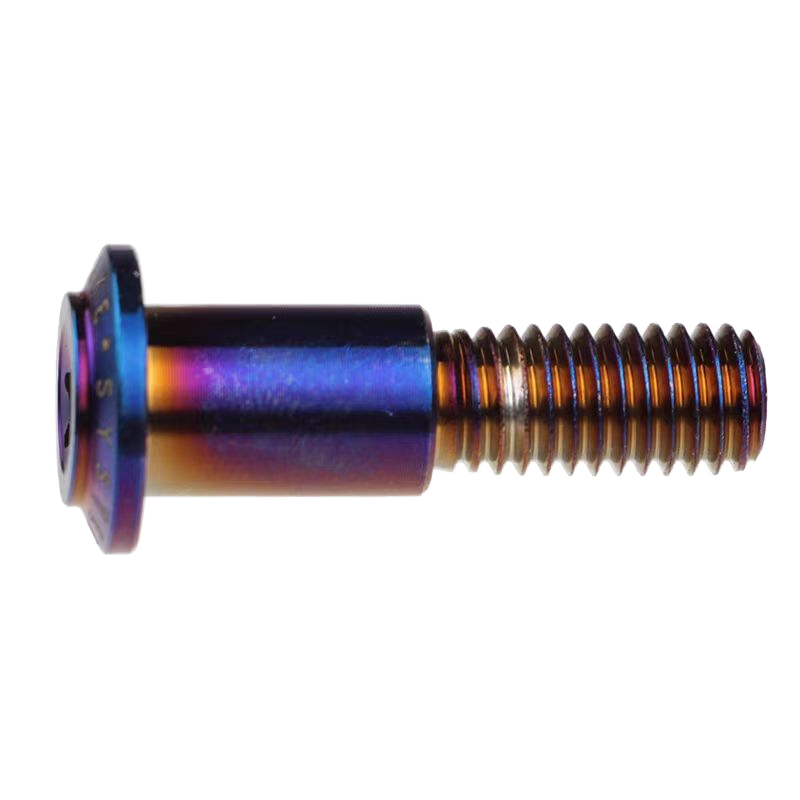
Hexagonal Stepped Flat Flange Disc Brake Bolts
- Structure:Stepped Shoulder Shank
- Machining:Swiss 5-Axis Turning
- Shear Strength:≥ 550 MPa
- Runout:< 0.01 mm Head-to-Shank
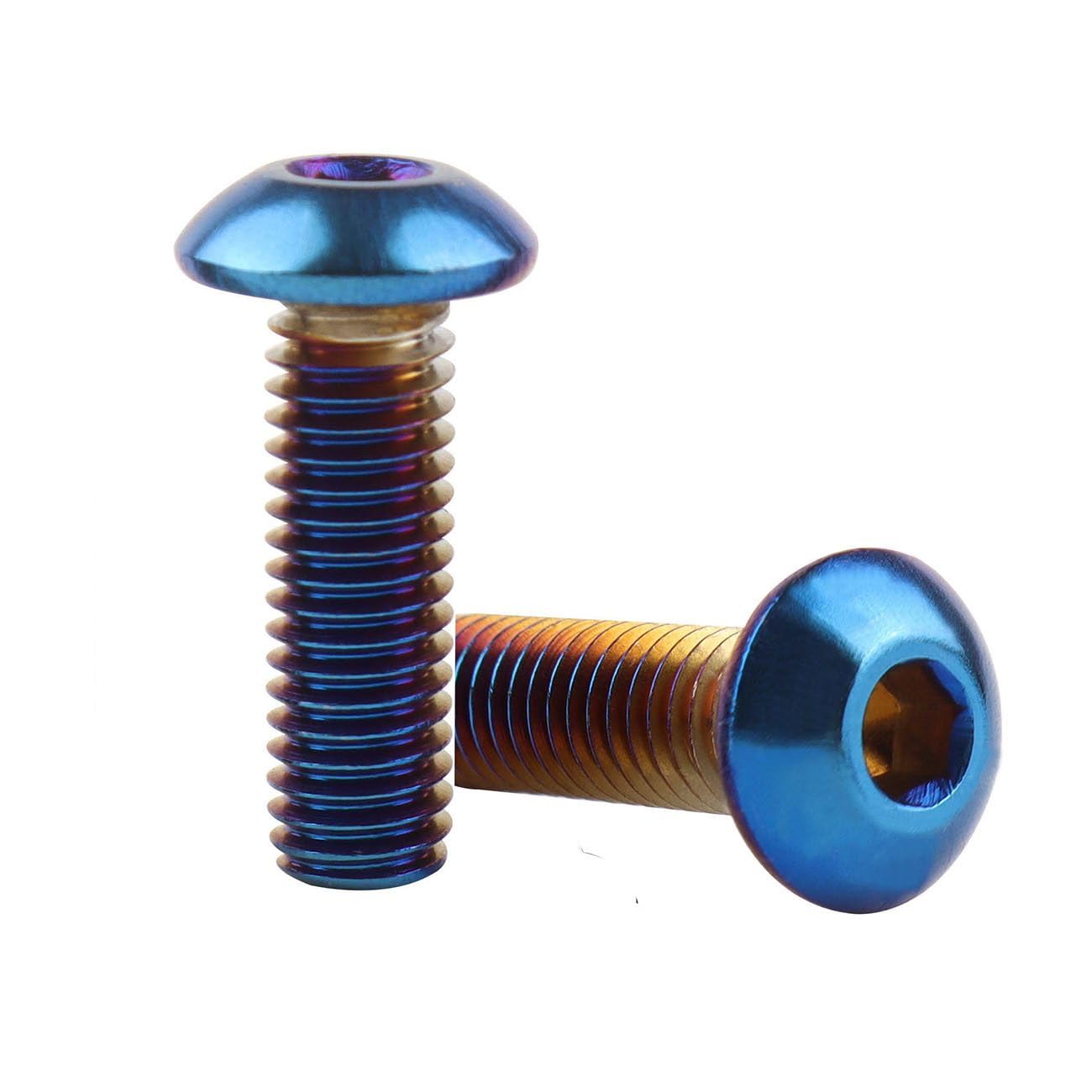
Titanium Finish Modification Bolt M6 Multi-Length
- Lengths:12mm to 35mm Flanged
- Head Type:Flanged Socket / Low Profile
- Alloy:ASTM B348 Grade 5
- Packaging:Vacuum Batch Sealed
1. Engineering Whitepaper: Mechanical Optimization of Custom Titanium Flange Bolts
In dynamic mechanical assemblies subjected to heavy shear amplitudes and harmonic vibrations, conventional hex bolts paired with loose washers introduce an inherent weak link: washer rotation, localized galling, and non-uniform clamp force propagation. A custom engineered Titanium Flange Bolt overcomes this mechanical limitation through an integrated, monolithic bearing flange that dramatically enlarges the contact surface area. By distributing clamping forces across a broader diameter, flange geometry eliminates localized surface yield on softer mating materials (such as magnesium engine casings, forged 6061-T6 aluminum hubs, and structural carbon fiber composites) while guaranteeing precise axial preload retention.
Manufactured strictly from vacuum-arc remelted (VAR) ASTM B348 Grade 5 (Ti-6Al-4V) titanium bars originating directly from Baoji’s certified ingot pools, our flange fasteners provide the optimum metallurgical convergence of tensile capacity, fracture toughness, and density reduction. Below is a comprehensive baseline metallurgical comparison illustrating why Gr5 titanium flange bolts replace Grade 8.8, 10.9, and 12.9 alloy steels in performance-critical industrial installations:
| Alloy Specification / Standard | Yield Strength ($R_{p0.2}$, MPa) | Ultimate Tensile ($R_m$, MPa) | Density ($\text{g/cm}^3$) | Specific Strength ($R_m / \rho$) | Corrosion Rate (Marine/Salt Air) |
|---|---|---|---|---|---|
| Gr5 Ti-6Al-4V (Annealed Bar) | ≥ 828 | ≥ 895–1,050 | 4.43 | 225 (Optimum) | < 0.0001 mm/year (Immune) |
| Gr2 Titanium (Commercially Pure) | ≥ 275 | ≥ 345 | 4.51 | 76 | < 0.0001 mm/year (Immune) |
| Medium Carbon Alloy Steel 8.8 | 640 | 800 | 7.85 | 102 | Requires Plating (Prone to Rust) |
| High-Tensile Alloy Steel 10.9 | 940 | 1,040 | 7.85 | 132 | High Risk of Hydrogen Embrittlement |
| AISI 316 Marine Stainless Steel | 290 | 620 | 8.00 | 77 | Susceptible to Crevice/Pitting Attack |
*Data verified in accordance with ASTM B348/B348M-21 and ISO 898-1 mechanical testing regimes. Specific strength represented as tensile strength divided by material density.
2. In-House Manufacturing Capabilities: Rooted in Baoji's Titanium Valley
Yevzo Titanium Metal Co., Ltd. has operated as an on-site verified manufacturer and export supplier since 2013, strategically headquartered in the High-Tech Development Zone of Baoji, Shaanxi Province. Renowned as China’s "Titanium Valley," Baoji represents over 60% of domestic titanium smelting, raw ingots, and secondary rod extrusion. This deep geographical cluster gives our engineering teams unrivaled supply chain velocity, heat-lot batch selection, and complete spectroscopic material traceability from initial sponge melting down to packed fasteners.
Unlike secondary machine shops that cut external threads onto pre-turned rod stock, our manufacturing facility relies on high-tonnage warm/cold heading coupled with continuous thread rolling. Thread rolling exerts massive compressive force between precision carbide rolling dies, plastically deforming the titanium grains along unbroken metallurgical flowlines. This fundamental structural grain preservation enhances fatigue resistance by up to 300% over cut threads and completely eliminates microscopic micro-cracks at the root radius.
Material Verification
ASTM B348 raw rods undergo optical emission spectrometry (OES) for chemical composition and ultrasonic non-destructive testing.
Warm Heading & Forging
High-precision multi-station heading equipment hot-upsets the integrated flange head, forming continuous unbroken internal grain contours.
Swiss 5-Axis Turning
Secondary shank shoulders, safety-wire holes, internal Torx/Hex sockets, and lightening dishes are cut to ±0.005mm tolerances.
CNC Thread Rolling
Controlled circular dies roll class 6g/4h6h external metric or UN threads under pressurized lubricant streams to preserve root radii.
Finishing & Surface QA
Automated ultrasonic solvent de-greasing followed by Type II anodizing, PVD magnetron sputtering, and 100% optical projector inspection.
Zero-Intermediary Factory Direct
By eliminating trading agents and brokers, our Baoji foundry provides direct access to senior metallurgical engineers, full mill test reports (MTR EN 10204 3.1), and rapid tooling turnaround for custom OEM drawings.
Extensive Tooling & Rapid Prototyping
Equipped with 100+ machining units, our workshop maintains standard tooling for DIN 6921, ISO 4162, JIS B1189, and aerospace AN/MS flange standards. Custom functional prototypes are typically completed within 5 business days.
Advanced Surface Treatment Suites
We provide in-house electrolytic anodizing (producing brilliant rainbow, cobalt blue, gold, and purple hues with zero dimensional buildup) as well as Physical Vapor Deposition (PVD) TiN, TiCN, and DLC coatings for high wear resistance.
3. Strategic Sourcing: Global Procurement Trends for Titanium Fasteners (2025–2030)
International B2B fastener procurement is undergoing profound structural shifts. Original equipment manufacturers, aerospace tier-suppliers, and motorsport racing divisions are transitioning away from ad-hoc commodity spot purchases toward long-term framework partnerships with certified source factories. Four pivotal market trends dominate modern titanium fastener procurement:
EV Weight & Range Optimization
Next-generation electric vehicle platforms prioritize unsprung mass reduction in wheel assemblies, brake calipers, and suspension arms. Shifting from steel lug bolts to Grade 5 titanium flange studs delivers immediate 40–45% mass savings at each wheel hub, enhancing battery range and damper transient response.
CFRP Galvanic Isolation
Carbon-fiber reinforced polymer (CFRP) structures cause severe galvanic corrosion when fastened with steel or aluminum due to differing electrochemical potentials. Titanium possesses an identical galvanic nobility to graphite fibers, making titanium flange bolts the global engineering baseline for composite chassis assembly.
Traceable Digital MTR Integration
Modern procurement guidelines require digital verification of chemical batch compositions, mechanical yield curves, and tensile proof loads under ASTM F606. Our automated serialization and micro-laser matrix marking allow instant verification of raw bar heat lots across every production run.
Multi-Currency Flexible Incoterms
To reduce supply chain disruption, international buyers are shifting from basic EXW/FOB models to fully insured DDP (Delivered Duty Paid) contracts. We support DDP, CIF, and FCA across USD, EUR, GBP, and JPY, handling domestic customs and port clearance smoothly.
4. Technological Frontiers: Next-Gen Titanium Flange Fastener Engineering
The titanium fastener manufacturing landscape is moving beyond conventional subtractive turning. Demanding operating parameters across hypersonic aerospace, cryogenic liquid propulsion, and high-performance racing drive technological innovation in three primary areas:
12-Point (Double-Hex) & Dimpled Flange Geometry
Traditional hex flanges require substantial tool envelope clearances. Next-gen aerospace programs utilize 12-point (MS21250 style) titanium flange bolts. These allow higher torque transmission through compact sockets while dished/dimpled head recesses eliminate up to 8% of non-structural mass from the head center without compromising structural integrity.
Anti-Galling Solid Film Nanocoatings
Titanium’s protective oxide layer ($TiO_2$) can break down under localized sliding friction against metals of similar hardness, causing severe galling. We integrate low-friction molybdenum disulfide ($MoS_2$) bonded dry films, tungsten carbide-carbon (WC/C), and ceramic-infused fluoropolymer micro-layers that reduce the thread friction coefficient ($K$) to a reliable 0.10–0.12 without messy external pasty greases.
Near-Net Shape Hot Radial Heading
Cold-forming alpha-beta titanium alloys presents challenges due to high yield ratios and rapid work hardening. Our newly installed induction-assisted warm radial forging lines preheat titanium blanks to tight temperature windows (600°C–650°C), preserving ductile grain structure while creating wide flanges with zero micro-shearing at the transition perimeter.
Frequently Asked Questions on Titanium Flange Bolts Sourcing
Direct metallurgical and logistics guidance from our engineering and international trade departments.
Why should an engineer select Grade 5 (Ti-6Al-4V) over Grade 2 for flange bolts?
How do you prevent thread galling (cold welding) during assembly?
- Always apply an anti-seize paste formulated with copper, nickel, or MoS2 before running down threads.
- For dry assembly requirements, specify our factory-applied MoS2 solid film lubricant or Diamond-Like Carbon (DLC) surface treatment.
- Use rolled threads rather than cut threads; cold-rolled flanks deliver a surface finish of Ra ≤ 0.4 μm, minimizing microscopic peak friction.
- Maintain recommended tightening speeds below 25 RPM when using automated drivers to prevent frictional heat spikes.
What are the tightening torque conversion rules when replacing steel bolts with Grade 5 titanium?
Does electrolytic color anodizing degrade the tensile strength or alter thread dimensions?
What is the Minimum Order Quantity (MOQ) and production turnaround for custom drawings?
- Prototype Phase: 10–20 pieces delivered in 5 to 7 working days.
- Pilot OEM Production: 200–1,000 pieces completed in 15 working days.
- Mass Batch Runs: 5,000+ pieces scheduled with recurring releases and safety buffer storage in our Baoji warehouse.
What quality assurance documentation accompanies export shipments?
- EN 10204 Type 3.1 Mill Test Certificate: Chemical element composition breakdown (Ti, Al, V, Fe, C, N, H, O) and room-temperature mechanical tensile/elongation properties.
- Dimensional Inspection Report: Flange diameter, under-head radius, thread runout, and pitch verified via optical comparator and calibrated thread ring go/no-go gauges.
- Surface Finish Report: Ra surface roughness measurements along the shank and flange bearing face.
Initiate Custom Flange Bolt Prototyping & OEM Sourcing
Connect directly with our Baoji application engineering division. Submit your PDF blueprints, CAD geometries, or required DIN/ISO standard dimensions. We provide comprehensive DFM (Design for Manufacturability) analysis, metallurgical grade confirmation, and formal quotations within 24 hours.