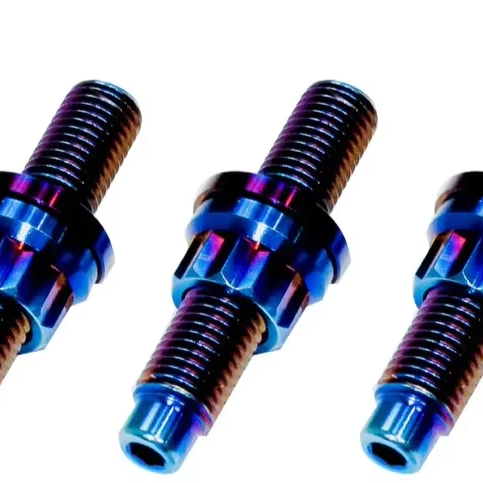
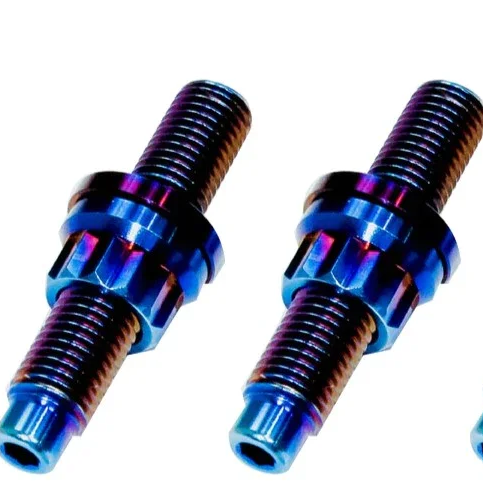
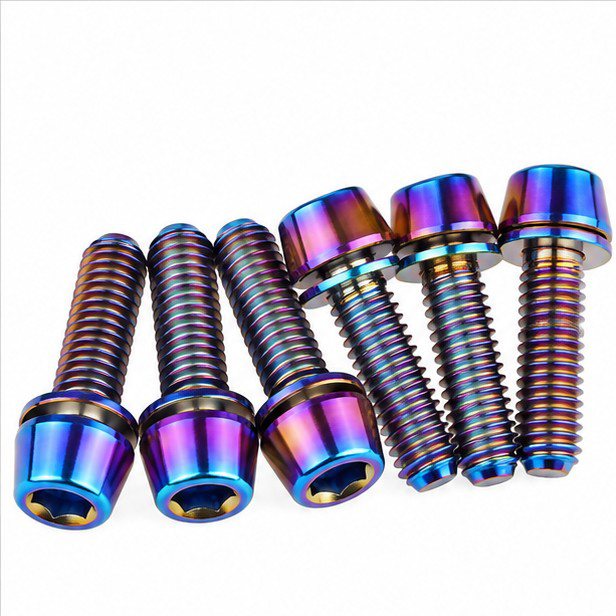
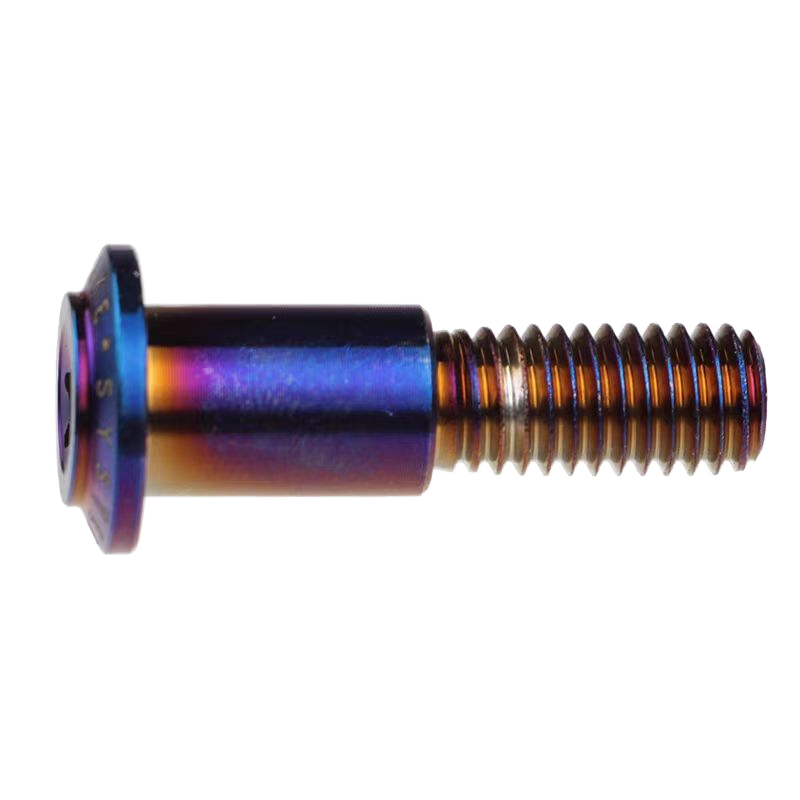
Engineering Architecture of Titanium Crank Bolts: The Metallurgical Paradigm
In high-torque powertrain systems, bicycle crank assemblies, and automotive drive accessories, structural fasteners are subjected to severe oscillating torsional stresses, micro-vibrations, and dynamic bending loads. Conventional Grade 8.8 or 10.9 zinc-plated carbon steel bolts, while providing sufficient initial tensile limits, present severe disadvantages: excessive un-sprung rotational mass, vulnerability to atmospheric electrolytic oxidation, and notch fatigue propagation under continuous cadence load cycles.
As premier China top titanium crank bolts manufacturers and exporters, our manufacturing process solves this mechanical bottleneck through metallurgy and CNC toolpath optimization. Certified Ti-6Al-4V Grade 5 (Alpha-Beta Titanium Alloy) delivers an unparalleled strength-to-weight ratio: a specific yield strength exceeding 187 kN·m/kg (compared to ~80 kN·m/kg for quenched structural steel), combined with total galvanic chemical inertness derived from an instantaneous, self-healing TiO₂ (Titanium Dioxide) passivation film.
Mechanical Properties & Structural Benchmark: Ti-6Al-4V vs Alternatives
Understanding the exact physical constants is vital for purchasing agents and mechanical design engineers specifying bolt clamping loads, joint elasticity, and fatigue life envelopes:
| Physical / Mechanical Attribute |
Gr5 (Ti-6Al-4V) Rolled Fastener |
Gr2 Commercially Pure (CP) |
Class 8.8 Carbon Steel |
7075-T6 Anodized Aluminum |
| Ultimate Tensile Strength (UTS) |
895 – 1050 MPa |
345 – 450 MPa |
800 – 830 MPa |
510 – 540 MPa |
| Yield Strength (0.2% Offset) |
828 – 920 MPa |
275 – 350 MPa |
640 – 660 MPa |
460 – 480 MPa |
| Volumetric Density (g/cm³) |
4.43 g/cm³ (≈44% Lighter) |
4.51 g/cm³ |
7.85 g/cm³ |
2.81 g/cm³ |
| Modulus of Elasticity (GPa) |
110 – 114 GPa (Elastic Damping) |
103 GPa |
205 – 210 GPa |
71 GPa |
| Fatigue Limit / Endurance (@10⁷ cycles) |
510 MPa |
180 MPa |
380 MPa |
160 MPa |
| Salt Spray Corrosion (ASTM B117) |
Exceeds 2,000 Hours (Corrosion Proof) |
Immune |
Red Rust < 96 Hours |
Pitting < 240 Hours |
| Clamping Elastic Reserve |
Superior (Prevents Dynamic Back-Off) |
Moderate |
Rigid / Prone to Snap |
Extremely Low (Creep Risk) |
Future Procurement & Manufacturing Trends in Titanium Fastener Engineering
The global mechanical components market is undergoing three distinct technical transitions that every international procurement director and technical distributor must incorporate into their multi-year supply contracts:
Cold-Heading + Rolled Thread Migration
Cut threading disrupts continuous grain boundaries, causing stress risers at the root diameter. The manufacturing trend demands warm micro-heading of Grade 5 blanks combined with CNC roll-forming of threads, increasing root fatigue life by over 300% under high cyclic crank oscillation.
PVD & Tribological Functional Coatings
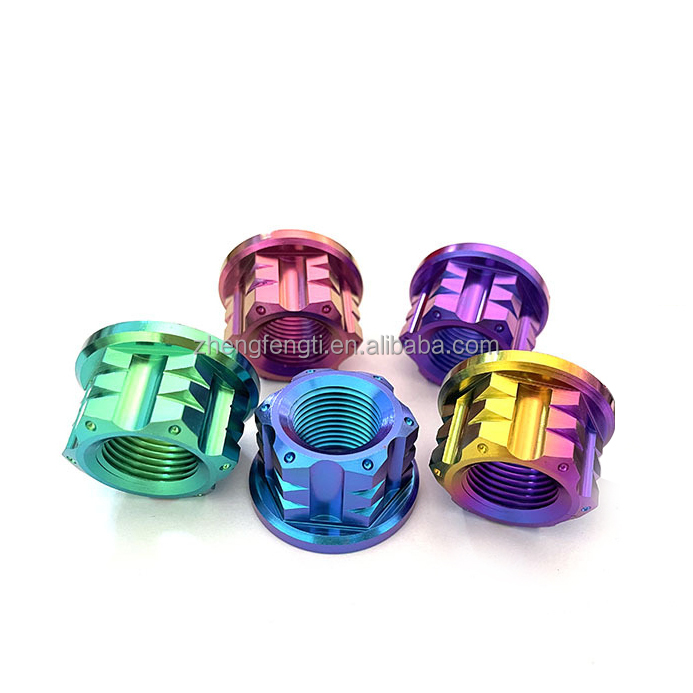
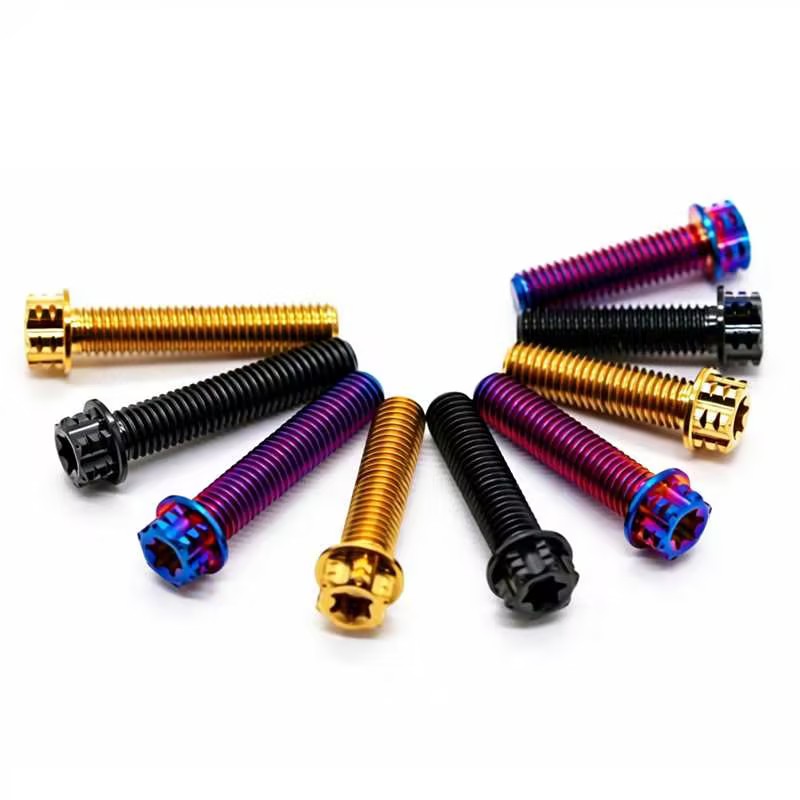
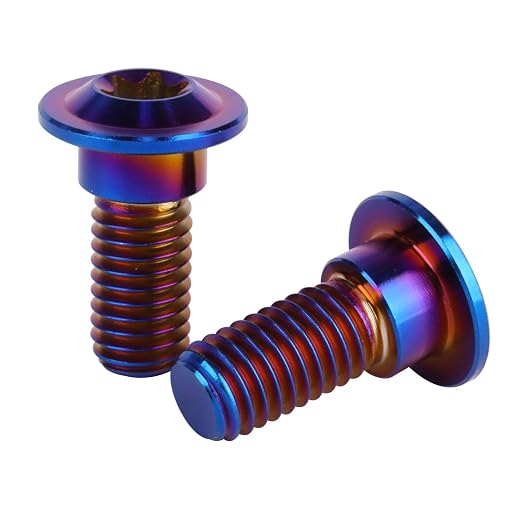
While visual appeal (such as Burnt Blue, Gold, and Rainbow) remains relevant in consumer cycling and motorcycle styling, enterprise OEM procurement now focuses on physical vapor deposition (PVD) of DLC (Diamond-Like Carbon) and TiAlN coatings to systematically suppress galling during high-speed pneumatic assembly.
Strict Heat-Lot Raw Material Traceability
With high-performance e-bikes, lightweight automotive suspension crank assemblies, and marine drivetrains demanding zero catastrophic shear risk, Tier-1 buyers require fully digitised MTRs (Mill Test Reports) compliant with ASTM B348 and EN 10204 3.1 inspection protocols on all bar stock.
Because Grade 5 titanium possesses roughly half the Young's modulus of carbon steel (~110 GPa vs ~210 GPa), a titanium bolt undergoes twice the elastic elongation under an identical bolt pre-load. In crank drives and drivetrain armatures, this elastic resilience acts as an internal lock washer, absorbing transient vibrational shocks without micro-loosening or backing out under rotational cadence shifts.
Enterprise Core Competencies: Why Global Sourcing Directs to Baoji
Operating from the epicentre of China's "Titanium Valley" in Baoji, Shaanxi, our facility maintains fully integrated, factory-direct manufacturing capabilities founded in 2013:
2013
Manufacturing Roots
100+
CNC & Machining Units
100%
Heat-Lot Ultrasonic Checked
5.0 / 5.0
Global Verified Buyer Index
Primary Source Manufacturer
We eliminate trading brokers and export intermediaries. From ASTM B348 bar peeling to CNC head turn-broaching, thread roll-forming, and ultrasonic cleaning, all operations occur directly on our Baoji production floor, delivering 25–40% cost efficiency.
Micro-Tolerance Metrology
Using digital optical profile projectors, 3D coordinate measuring machines (CMM), and go/no-go ring gauges calibrated to ISO 965 Class 6g standards, we maintain dimensional tolerance accuracy within ±0.01 mm across batch productions exceeding 500,000 units.
Global Trade Flexibility
Our sales infrastructure supports flexible cross-border commerce: FOB, CFR, CIF, EXW, FCA, CPT, DDP, and door-to-door express. Settlement currencies include USD, EUR, GBP, JPY, and AUD via T/T, L/C, PayPal, and trade escrow instruments.
Procurement & Engineering FAQ: Titanium Crank Fastener Sourcing
Authoritative technical solutions formulated by our metallurgical staff to address the most critical questions in international titanium fastener procurement:
Why must titanium crank bolts be specified in Ti-6Al-4V Grade 5 rather than Grade 2?
Grade 2 titanium is commercially pure (CP) with an unalloyed UTS limit of roughly 345–450 MPa. In dynamic drivetrain and crank arm connections, cyclic shear and tightening torques exceed 35–45 Nm, which causes immediate plastic deformation and thread yield in Grade 2. In contrast, Grade 5 (Ti-6Al-4V) is an alpha-beta structural alloy heat-treated to achieve minimum tensile strengths of 895–1050 MPa and yield strengths of 828 MPa, delivering double the clamp load safety margin of Class 8.8 steel bolts.
How should engineers and mechanics prevent thread galling (cold welding) during assembly?
Titanium's tenacious surface oxide film can cause microscopic friction galling if torqued dry into mating titanium, stainless steel, or aluminum threads. We recommend applying an anti-seize paste formulated with copper, nickel, or molybdenum disulfide (MoS₂) to all threads and seating washers. Furthermore, our factory can apply specialized PVD (Physical Vapor Deposition) or hard anodizing treatments to diminish the friction coefficient from µ=0.35 to under µ=0.12.
What is the recommended tightening torque for titanium crank bolts compared to steel?
Due to titanium's distinct friction coefficient and elastic elongation, bolts should not simply be torqued to generic steel ratings. For an M8 Grade 5 crank bolt with anti-seize paste lubrication, the standard recommended torque envelope is 28 to 35 N·m (compared to 40 N·m on unlubricated steel). Applying torque to a lubricated fastener achieves proper clamping force at a lower applied torque, preventing stress failure.
What are the minimum order quantities (MOQ) and production lead times for custom drawings?
For standard stock products (e.g., M5, M6, M8 stem and crank bolts, hex nuts), our minimum order quantity starts as low as 10 to 30 pieces. For custom CNC machined components or specialized cold-headed OEM prints (STEP/DWG files), prototype tooling runs typically start at 100 to 200 pieces. Standard lead times range from 7–10 business days for stocked bar turning to 20–25 days for complex custom geometry and PVD color batches.
Does color anodizing compromise the structural integrity or dimensional tolerance of the thread?
No. Titanium anodizing is fundamentally different from aluminum anodizing. It is an electrolytic process that modifies the thickness of the refractive surface titanium dioxide (TiO₂) film through precise voltage application (15V to 110V) without pigment dyes. The resulting film thickness is measured in nanometers (10–200 nm), leaving thread tolerances (ISO 6g/6H) intact with zero dimensional buildup or micro-cracking.
Request Engineering Quotations & Technical D/P Packs
Looking for a dependable China manufacturing partner for custom titanium crank bolts, flanged drive hardware, or ASTM B348 bar stock? Share your CAD drawings, required thread standards, and annual volume projections with our Baoji engineering office.